
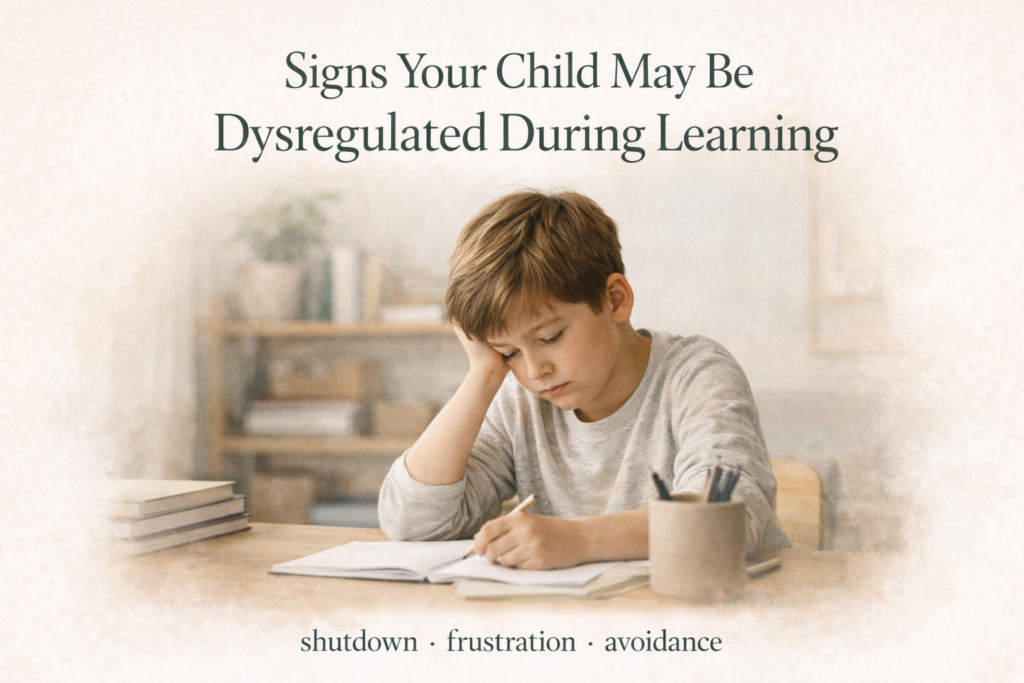
Why children shut down during schoolwork—and what it actually means for neurodivergent and overwhelmed learners
By Zachary James, M.S.Ed., M.Ed. (Educational Leadership) Founder & Director, Adaptive Learning Academy
This article is based on the Regulation-First Learning Framework™, a core model within the Adaptive Pedagogy Framework™ developed by Adaptive Learning Academy.
Many parents notice a confusing and often frustrating pattern during schoolwork. Their child may understand the material. They may be capable of explaining concepts out loud. They may even show curiosity and engagement at other times And yet—when it is time to begin the work, something shifts. Assignments that should be manageable feel impossible to start. Simple tasks trigger disproportionate frustration. A calm child becomes overwhelmed within minutes.
Parents often ask: Why does my child shut down during schoolwork?
For many neurodivergent and trauma-impacted learners, the answer is not found in academic ability alone. It begins with the nervous system.
Before We Go Further: A Quick Lens Shift for Parents
Before diving deeper, it can be helpful to pause and reframe the question.
Instead of asking:
“Why won’t my child do this?”
We begin with:
“What might be making this hard to access right now?”
This shift is not just philosophical—it changes how we interpret behavior, and ultimately how we respond.
Here are the 5 Signs Your Child May Be Dysregulated During Learning. Your child may understand the material—but still struggle to start, continue, or complete schoolwork. This is often not a motivation issue, but a regulation issue. Many parents notice the same patterns:
- difficulty initiating tasks despite understanding
- strong emotional reactions to small challenges
- shutting down mid-assignment
- avoidance of work they can otherwise do
- appearing “lazy” or unmotivated when they are actually overwhelmed
These are not behavior problems—they are signals from the nervous system. If you recognize these patterns, you’re not alone—and there’s a reason this happens. If you are trying to understand whether your child’s struggle is rooted in learning or regulation, you can start here: → Is This a Learning Problem or a Regulation Problem?
This guide will help you begin identifying patterns as you read.
What Does Dysregulation Actually Mean?
Dysregulation occurs when the nervous system becomes overwhelmed and loses its ability to maintain a balanced state. This is not a behavioral choice. It is a physiological response.
When the brain perceives stress—whether emotional, cognitive, or sensory—it shifts away from higher-level thinking systems and toward survival-based responses.
These responses typically fall into four categories:
- fight
- flight
- freeze
- shutdown
These are controlled by the autonomic nervous system and are designed to protect—not to disrupt. According to the Child Mind Institute, when children experience stress or overload, the brain systems responsible for reasoning, planning, and learning become significantly less accessible.
This is why a child who appears capable in one moment may struggle dramatically in the next. The issue is not knowledge. It is access.
Why Dysregulation Shows Up So Often During Learning
Learning is not a single skill. It is a layered process that requires multiple brain systems to work together simultaneously.
During even a “simple” assignment, a child must:
- initiate the task
- hold instructions in working memory
- organize materials
- regulate frustration
- sustain attention
- tolerate uncertainty
- complete multiple steps in sequence
This is a significant cognitive load. We explore this more deeply in: → Executive Function and Learning: What Parents Need to Know
When this load exceeds what the brain can manage in that moment, the nervous system steps in—and when the nervous system steps in, learning steps back.
Signs Your Child May Be Dysregulated During Learning
Dysregulation does not always look dramatic. In fact, the most significant signs are often the quietest. Some children externalize their overwhelm. Others internalize it. Both are forms of dysregulation.
Common signs include:
- difficulty starting tasks despite understanding
- sudden emotional escalation over small challenges
- shutting down mid-assignment
- increased frustration with mistakes
- needing frequent breaks to continue
- appearing mentally exhausted after short periods
- avoiding schoolwork altogether
What many parents notice most is inconsistency. A child may complete work with ease one day and struggle intensely the next. This inconsistency is not random, it is often a reflection of fluctuating nervous system capacity.
When a Child Shuts Down During Schoolwork
Shutdown is one of the most misunderstood responses.
It often looks like:
- refusal
- disengagement
- lack of effort
But neurologically, shutdown is a form of freeze response. The brain is not choosing to disengage. It is attempting to reduce overwhelm by limiting input and output.
A child in shutdown may:
- stop responding verbally
- avoid eye contact
- become still or withdrawn
- refuse to continue
From the outside, this can feel oppositional. From the inside, it often feels like:
“I don’t know where to start, and I can’t figure it out.”
We explore this distinction further here: → Learning Problem vs Regulation Problem in Neurodivergent Learners
Understanding this difference is foundational, because the response to each is very different.
Featured Article
We recently explored this topic further in a guest feature with Teacher Treasury, looking at why some students shut down during academic tasks—and what those moments may actually mean beneath the surface.
If your child or student understands the work but cannot consistently begin, engage, or follow through, this article may help connect executive function, regulation, and overwhelm more clearly.
→ Read the full article: Why Some Students Shut Down During Academic Tasks
The Role of Cognitive Load
One of the most important—and often overlooked—contributors to dysregulation is cognitive load.
Cognitive load refers to the amount of mental effort required to complete a task. When that load becomes too high, the brain cannot sustain engagement. Instead, it shifts toward protection.
Common sources of increased cognitive load:
- multi-step directions
- unclear starting points
- time pressure
- unfamiliar or abstract tasks
- sensory-heavy environments
- internal pressure to “get it right”
Even when a child understands the content, the structure of the task itself can become the barrier. This is why reducing cognitive load often improves performance without changing the content.
We expand on this in: → Regulation-First Learning: What It Means and Why It Matters
What Patterns Are You Noticing?
At this point, many parents begin recognizing patterns they hadn’t previously connected.
You may be noticing:
- your child struggles more at certain times of day
- transitions are particularly difficult
- starting is harder than completing
- emotional responses seem disproportionate to the task
These are not random. They are data points. If you want a structured way to track these patterns, you can use— Download the Free Guide: Is This a Learning Problem or a Regulation Problem?
This can help you move from guessing to observing with clarity.
The Adaptive Learning Pedagogy Framework™
At Adaptive Learning Academy, we approach learning through a regulation-first lens. Because learning does not begin with instruction. It begins with access.
The sequence matters:
- Regulation: The nervous system must feel safe and stable enough to engage.
- Connection: A supportive presence reduces threat and increases capacity.
- Engagement: In engagement, learning becomes possible when access is restored.
- Learning: Focus, curiosity, and problem solving become easier to access.
This is not about lowering expectations. It is about creating conditions where expectations can be met.
What This Looks Like in Practice
When a child is dysregulated, increasing pressure rarely improves outcomes. In fact, it often intensifies the problem.
Instead, small shifts can significantly improve access:
- reducing task length
- clarifying the first step
- offering visual structure
- allowing movement breaks
- adjusting the environment
- sitting alongside rather than directing
These are not accommodations in the traditional sense. They are access points. When access improves, performance often follows naturally.
How Structure Supports Regulation
Structure is not rigidity. It is predictability. For many children, uncertainty increases cognitive load. Structure reduces that load.
When a child knows:
- what is expected
- where to begin
- what comes next
their nervous system does not need to stay in a heightened state. This is why visual tools and planning systems can be so effective. They externalize what the brain is trying to hold internally.
Many families use structured tools like the Adaptive Learning Academy Planner to:
- break tasks into manageable steps
- create predictable routines
- reduce decision fatigue
When Dysregulation Is Misinterpreted
One of the most common—and costly—misinterpretations is labeling dysregulation as defiance.
Because from the outside, it can look like:
- refusal
- avoidance
- lack of motivation
But most children are not choosing to struggle. They are navigating a system that exceeds their current capacity.
When adults shift from:
“Why won’t they do this?”
to:
“What is making this hard to access?”
everything begins to change.
Continue Reading
If this perspective shifted how you’re viewing your child’s learning, the next step is understanding what to do in the moment—not just what’s happening.
These articles will help you go deeper:
→Learning Problem vs Regulation Problem in Neurodivergent Learners: Learn how to distinguish between true academic gaps and nervous system overwhelm—so you can respond appropriately instead of guessing.
→Regulation-First Learning: What It Means and Why It Matters: Understand why traditional academic approaches often fail dysregulated learners—and what to do instead.
→Executive Function and Learning: What Parents Need to Know: Explore how task initiation, working memory, and organization directly impact your child’s ability to engage with schoolwork.
→How Trauma Impacts the Brain and Learning: Understand how trauma affects the nervous system, brain development, and a child’s ability to access learning in real time.
Not Sure Where to Start?
If you’re still trying to figure out what’s actually going on for your child during learning, start here: Is This a Learning Problem or a Regulation Problem?
This guide will walk you through:
- how to identify patterns of dysregulation
- what behaviors actually mean
- how to begin responding in a way that supports learning
Final Thoughts
When a child struggles during learning, it is easy to focus on the academic surface. But beneath that surface is a much more important question: Can the brain access learning right now?
For many neurodivergent and trauma-impacted learners, the answer changes moment to moment. Not because ability changes, but because access does.
When we begin to recognize the role of the nervous system, we stop trying to force learning through overwhelm—and instead, we begin to build pathways toward it.
Because when the brain feels safe enough to engage— learning doesn’t have to be forced. It begins to emerge.
About the Author
Zachary James, M.S.Ed., M.Ed. (Educational Leadership) is the Founder and Director of Adaptive Learning Academy. He holds two master’s degrees in education and has served as an educator, instructional coach, and school administrator. His work focuses on regulation-first pedagogy, executive function development, and trauma-informed educational systems designed to support neurodivergent and complex learners.
The Adaptive Pedagogy Framework™ and Regulation-First Learning Framework™ were developed by Zachary James and Adaptive Learning Academy.