
When a Capable Child Can’t Start: The Hidden Executive Function Barrier
By Zachary James, M.S.Ed., M.Ed. (Educational Leadership) Founder & Director, Adaptive Learning Academy
This article is based on the Regulation-First Learning Framework™, a core model within the Adaptive Pedagogy Framework™ developed by Adaptive Learning Academy.
If your child is bright, capable, and able to explain ideas verbally—but struggles to begin schoolwork, finish assignments, or stay organized—you are not alone. This is one of the most common and misunderstood learning challenges among parents and educators. Many children understand the material but cannot start tasks, complete assignments, or follow through independently. This gap between understanding and execution is rarely about motivation. It is most often an executive function challenge—and understanding it can completely change how you support learning at home or in the classroom.
The Pattern That Leaves Parents and Teachers Confused
There is a moment many parents and educators recognize instantly. A child is sitting in front of their work: They understand the material. They’ve done something similar before. They may even say, “I know this.” And yet… nothing happens.
Or what does happen looks like:
- avoidance
- frustration
- emotional escalation
- shutting down
- or taking hours to complete something that should take minutes
This is often the point where adults begin to interpret behavior:
“They’re not trying.”
“They’re being difficult.”
“They just need more discipline.”
But this interpretation misses what is actually happening inside the brain. Because for many children, this is not refusal. It is overload.
If this is starting to feel familiar, you’re not missing something. Many learning challenges are not rooted in ability — they’re connected to regulation and how the brain is responding underneath. If you want a clear way to begin sorting this out for your child: → Start with the free guide inside our regulation-first email series
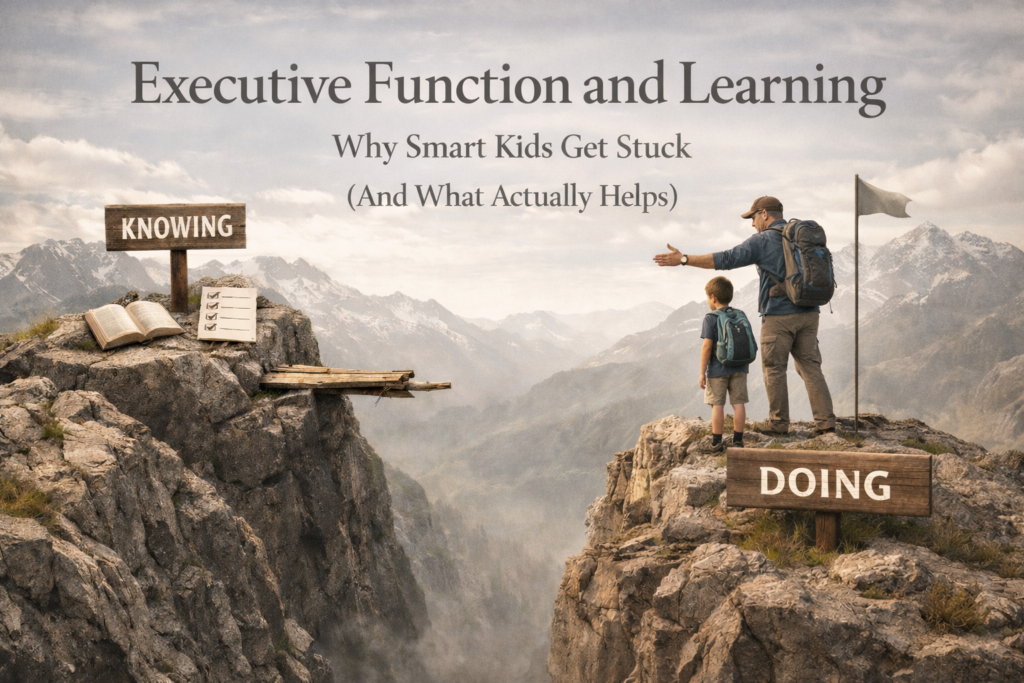
Executive Function: The Bridge Between Knowing and Doing
Executive function is often described as a group of cognitive skills, but more accurately, it is the system that allows a child to translate understanding into action.
It includes:
- task initiation (starting work)
- working memory
- planning and organization
- attention control
- cognitive flexibility
- emotional regulation
These skills act as the brain’s management system.
When executive function is working well, a child can:
- begin tasks without significant delay
- follow multi-step directions
- manage materials and time
- stay engaged through completion
When executive function is strained, even simple tasks can feel overwhelming. This is why so many capable children struggle in ways that seem inconsistent.
Why Executive Function Breaks Down
One of the most important truths about executive function is this: It is not just about skill—it is about access.
A child can have the ability…
…but lose access to it under the wrong conditions.
Executive function becomes harder to access when:
- tasks feel too large
- instructions are unclear
- multiple steps are required
- pressure increases
- cognitive load builds
This is why parents and teachers often see inconsistency.
A child may complete work easily one day…
…and struggle significantly the next.
The difference is not intelligence. The difference is how much the brain is being asked to manage at once and whether or not the child is regulated.
This is often the point where things begin to shift. When you can clearly see whether something is a learning issue or a regulation issue, your response changes — and that’s when progress becomes possible.
If you want a structured way to walk through this for your own child start here with the: Free Regulation Guide
The Role of Working Memory: The Invisible Bottleneck
Working memory is one of the most critical—and most overlooked—components of executive function.
It allows the brain to:
- hold instructions in mind
- track steps during a task
- connect ideas
- apply knowledge in real time
Students rely on working memory constantly:
- solving math problems
- following directions
- writing responses
- reading comprehension
When working memory becomes overloaded:
- instructions are forgotten mid-task
- steps are skipped
- accuracy decreases
- frustration increases
According to the Harvard Center on the Developing Child, executive function skills like working memory are foundational to learning and are highly sensitive to stress and cognitive load. This is why many children appear capable verbally—but struggle to execute independently.
Why “Just Start Your Work” Doesn’t Work
From an adult perspective, starting a task seems simple. But for a child experiencing executive function strain, starting is often the hardest step.
Because “starting” requires:
- identifying the first step
- organizing materials
- filtering distractions
- managing internal resistance
- tolerating uncertainty
When these demands exceed capacity, the brain does not initiate action. It pauses. Or avoids. Or escalates. What looks like defiance is often: task initiation paralysis.
When pressure increases, the problem typically gets worse—not better.
Executive Function Is Tied to Regulation (Not Just Skill)
Executive function does not operate independently from the nervous system. It depends on it.
When a child is:
- calm
- regulated
- feeling safe
Executive function becomes more accessible.
When a child is:
- overwhelmed
- anxious
- dysregulated
Executive function becomes significantly harder to access. This is why learning can appear inconsistent—and why pushing harder often backfires.
If you want to understand this more deeply, start here: 👉 Regulation-First Learning: What It Means and Why It Matters
When we try to build executive function on top of dysregulation, we are working against the brain.
Executive Function, Stress, and Trauma
For children impacted by chronic stress or trauma, executive function challenges may be even more pronounced. The brain prioritizes safety over higher-level thinking.
This can affect:
- attention
- working memory
- planning
- flexibility
- emotional control
You may notice:
- quicker overwhelm
- difficulty starting tasks
- inconsistent performance
- emotional responses tied to schoolwork
This is not a behavior issue. It is a neurological response. We explore this more deeply here: 👉 How Trauma Impacts the Brain and Learning
Understanding this connection allows us to respond with support instead of escalation.
When It Looks Like a Learning Problem (But Isn’t)
One of the most important distinctions parents and educators can make is this:
Is the child struggling because they don’t understand… Or because they can’t execute?
These require completely different approaches. A learning problem requires more instruction.
An executive function problem requires:
- reduced cognitive load
- clearer structure
- support for task initiation
- regulation support
Many families and professionals stay “stuck” because they are trying to solve the wrong problem. This is often where the biggest “aha” moment happens for parents and educators. If you’re unsure, this is exactly why we created: Is This a Learning Problem or a Regulation Problem?
Reducing Cognitive Load: Where Real Change Begins
If executive function is overloaded, the solution is not more pressure. It is reducing the load. Cognitive load is the total mental effort required to complete a task. When that load is too high, the brain cannot engage effectively.
Reducing cognitive load might include:
- breaking tasks into smaller steps
- shortening assignments
- simplifying instructions
- focusing on one concept at a time
- reducing competing demands
These adjustments do not lower expectations. They make success possible.
This is also where structured supports—like consistent planning systems and accommodations—can begin to make a meaningful difference when used intentionally.
Why Structure Supports Executive Function (Without Rigidity)
Structure is not about control. It is about clarity.
When a child knows:
- what to expect
- where to begin
- how tasks are organized
…the brain can engage more easily. This is why many families benefit from consistent visual systems.
Tools like structured planners can help reduce:
- decision fatigue
- overwhelm
- task initiation barriers
Not because they force compliance—but because they reduce cognitive load.
The Adaptive Learning Framework™ and Executive Function
Within the Adaptive Learning Framework™, executive function is addressed through three core layers:
- Regulation First: We assess whether the child’s nervous system is in a state that allows access to executive function.
- Cognitive Load Adjustment: We modify task demands so the brain can engage without overload. This is where intentional accommodations can support access without lowering expectations.
- Structured Support Systems: We introduce consistent systems that reduce decision-making and support task initiation. This is where tools like planners and structured routines become supportive—not as a solution alone, but as part of a larger approach.
When these layers align, something shifts: The child can begin; and once they begin—learning becomes more accessible.
What This Looks Like in Real Life
Instead of:
“Just start your work.”
We shift to:
“Let’s find the first step together.”
Instead of:
“You’re not trying.”
We shift to:
“This might feel like a lot—let’s make it smaller.”
Instead of:
“You know this.”
We shift to:
“Your brain might be overloaded right now.”
These small shifts reflect a deeper understanding of how learning actually works.
Explore More Articles
If this topic resonated, these articles will help you go deeper:
• Regulation-First Learning: What It Means and Why It Matters
• How Trauma Impacts the Brain and Learning
• Learning vs Regulation: How to Tell the Difference in Struggling Students
Start Here
If you’re beginning to see these patterns, this is the best place to start: Is This a Learning Problem or a Regulation Problem?
A practical, parent-friendly resource to help you identify patterns, reduce overwhelm, and begin responding in ways that actually support your child’s brain.
Final Thoughts
Executive function is not something children simply “grow into”—especially when expectations continue to increase without adjusting support.
What we see, over and over again, are children who are fully capable of learning… but consistently placed in situations where the demands exceed what their brain can manage. And when that happens repeatedly, it doesn’t just impact schoolwork It impacts identity.
Children begin to believe:
- “I’m behind.”
- “I’m not good at this.”
- “Something is wrong with me.”
But in reality, what is often missing is not ability. It is alignment.
Alignment between:
- what is being asked of the child
- and what their brain can access in that moment
This is why our work focuses less on fixing the child—and more on adjusting the environment, expectations, and approach. Because when the system around the child changes, something important happens:
They begin to access what was already there. Not perfectly Not all at once, but consistently enough to build confidence. And that’s where real learning begins.
Executive function challenges are not a reflection of intelligence.
They are a reflection of how the brain is managing:
- load
- stress
- structure
- and support
When we understand this, we stop escalating. We start supporting. And when the brain is supported in the right way…Learning becomes accessible again.
About the Author
Zachary James, M.S.Ed., M.Ed. (Educational Leadership) is the Founder and Director of Adaptive Learning Academy. He holds two master’s degrees in education and has served as an educator, instructional coach, and school administrator. His work focuses on regulation-first pedagogy, executive function development, and trauma-informed educational systems designed to support neurodivergent and complex learners.
The Adaptive Pedagogy Framework™ and Regulation-First Learning Framework™ were developed by Zachary James and Adaptive Learning Academy.