
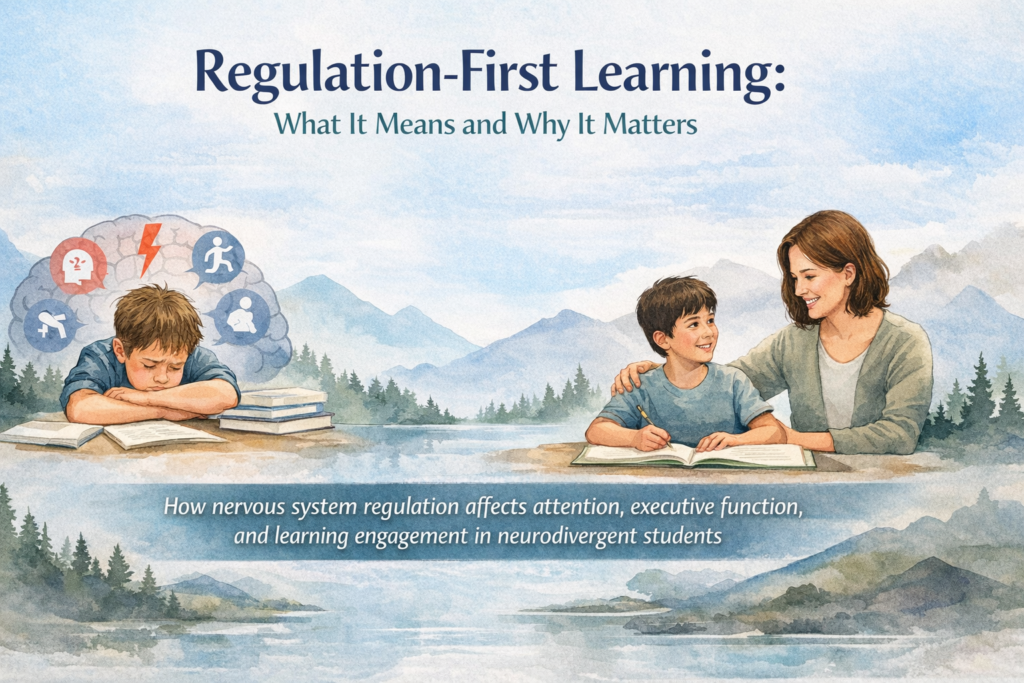
How nervous system regulation affects attention, executive function, and learning engagement in neurodivergent students
By Zachary James, M.S.Ed., M.Ed. (Educational Leadership) Founder & Director, Adaptive Learning Academy
This article is based on the Regulation-First Learning Framework™, a core model within the Adaptive Pedagogy Framework™ developed by Adaptive Learning Academy.
Many parents notice a confusing pattern. Their child understands the material. They can explain ideas verbally. They may even show curiosity about learning. But when schoolwork begins, everything changes. Frustration appears quickly. Focus disappears. Assignments feel impossible to start.
In many cases, the challenge isn’t academic ability. The challenge is nervous system regulation.
For neurodivergent learners, including students with ADHD, executive function differences, sensory sensitivities, or developmental trauma histories, the brain often needs regulation before academics in order for learning to happen.
Understanding this concept can dramatically change how families approach school, homework, and daily learning routines. Instead of assuming a child simply needs more practice, more motivation, or more discipline, parents begin to recognize that learning depends on the brain’s ability to access cognitive systems.
When those systems are overwhelmed, academic pressure alone rarely solves the problem.
What Is Regulation-First Learning?
Regulation-first learning is an educational approach based on a fundamental neurological principle: Learning becomes much harder when the nervous system is overwhelmed.
When a child experiences stress, pressure, sensory overload, or emotional threat, the brain shifts resources away from higher-level thinking and toward protection. In this state, cognitive systems responsible for: focus, working memory, task initiation, reasoning, executive function, become harder to access.
This shift happens automatically. It is not a behavioral choice. The brain simply prioritizes survival over cognition.
This is why pushing academics during moments of dysregulation often leads to more frustration rather than progress. A child may appear resistant, distracted, or unmotivated when the underlying issue is that the brain cannot easily access the systems needed for learning.
Regulation-first learning focuses on supporting the nervous system first, allowing the brain to return to a state where attention, problem solving, and curiosity can re-engage.
At Adaptive Learning Academy, we often describe this process as creating the conditions where learning becomes possible again.
The Brain and Nervous System Regulation
The brain constantly evaluates whether an environment feels safe or overwhelming.
This process occurs through the autonomic nervous system, which monitors signals related to stress, predictability, cognitive demand, and emotional safety.
When the brain perceives threat or overload, it may activate survival responses such as:
- fight
- flight
- freeze
- shutdown (disassociation)
These responses are not signs of defiance. They are automatic neurological reactions designed to protect the body. When the autonomic nervous system shifts into survival mode, activity in the prefrontal cortex — the area responsible for reasoning, planning, working memory, and impulse control — decreases.
In practical terms, this means the brain temporarily loses access, to many of the systems required for academic engagement.
Research from the Center on the Developing Child at Harvard University explains that chronic stress can significantly affect cognitive processes such as attention, memory, and executive function.
When the brain is operating under stress, even simple academic tasks can suddenly feel overwhelming.
Understanding this neurological reality helps explain why academic pressure often escalates learning struggles rather than resolving them.
Why Regulation Must Come Before Academics
Parents often try to increase motivation when learning becomes difficult. They may encourage persistence, offer incentives, or increase structure. But when the nervous system is dysregulated, motivation is rarely the primary barrier. Instead, the brain may simply be unable to access the cognitive systems needed for learning.
This is why regulation-first learning often follows a predictable sequence.
Regulation > Connection > Simplification > Learning
- First—the nervous system needs to move out of survival mode and into a state where attention and curiosity can return. This may involve sensory supports, movement, quiet environments, or reduced expectations in the moment.
- Second— the adult builds supportive relationship to help children feel safe and understood. Emotional safety lowers nervous system stress and increases learning readiness.
- Third— Reducing cognitive load allows the brain to re-engage gradually. Examples include shorter assignments, simplified instructions, or breaking tasks into smaller steps.
- Lastly—once regulation stabilizes, cognitive engagement often returns naturally, allowing for retention and learning. Focus improves, emotional reactivity decreases, and curiosity becomes easier to access.
This sequence forms the foundation of the Adaptive Learning Academy regulation-first framework.
We explore this idea further in our guide on: Learning Problem vs Regulation Problem in Neurodivergent Learners
The Role of Co-Regulation
Children rarely learn regulation entirely on their own. Instead, regulation develops through co-regulation, the process by which a calm and supportive adult helps stabilize a child’s nervous system.
Co-regulation may include:
- calm tone of voice
- predictable routines
- emotional presence
- supportive guidance
- patient pacing
Through these interactions, the brain gradually learns how to return to a regulated state.
For many neurodivergent learners, co-regulation remains important well beyond early childhood. When adults respond to dysregulation with patience and stability, the nervous system begins to settle.
Once regulation improves, learning becomes much more accessible.
Cognitive Load and Learning Overwhelm
Another important concept connected to regulation-first learning is cognitive load.
Cognitive load refers to the amount of mental effort required to process information and complete tasks. Neurodivergent learners often experience increased cognitive load due to differences in executive function, working memory, or sensory processing.
When cognitive load becomes too high, learners may experience:
- frustration
- confusion
- shutdown
- refusal to begin work
Reducing cognitive load can dramatically improve learning engagement.
Examples include:
- fewer problems on a worksheet
- shorter assignments
- visual schedules
- breaking tasks into smaller steps
- structured planning tools
These adjustments do not lower expectations. They simply make learning accessible again.
Families who want a structured way to plan accommodations often use tools like our Neurodivergent Learning Accommodations Guide which helps identify learning barriers and design supportive strategies across sensory, emotional, and instructional domains.
You can also explore more strategies in our article on: Executive Function and Learning: What Parents Need to Know
Why Regulation-First Learning Matters for Neurodivergent Learners
Neurodivergent learners often experience increased demands on:
- executive function
- sensory processing
- emotional regulation
- working memory
Traditional learning environments can unintentionally increase these demands through rigid pacing, large classrooms, and constant attention expectations.
When cognitive and emotional load becomes too high, the nervous system may respond with:
- refusal
- shutdown
- avoidance
- emotional escalation
These responses are often misunderstood as behavioral issues when they are actually signals of neurological overload. Recognizing these patterns helps families shift from pressure-based approaches to support-based learning strategies.
In many cases, learning returns once the nervous system stabilizes.
Practical Examples of Regulation-First Learning
Parents often ask what regulation-first learning looks like in everyday life. In practice, it often involves small but meaningful adjustments.
Examples include:
- allowing movement breaks before beginning work
- creating quieter learning environments
- shortening assignments during difficult seasons
- using visual planning tools
- building predictable routines
- alternating cognitive and physical activities
Many families find it helpful to use structured planning systems that support both regulation and executive function organization.
Our Adaptive Learning Academy planner systems were designed to help families reduce cognitive overload while maintaining clear structure for learning.
Regulation-First Learning and Hybrid Education
Many families exploring flexible education models discover that hybrid learning environments naturally support regulation-first strategies.
Hybrid learning structures often allow for:
- flexible pacing
- sensory breaks
- smaller academic blocks
- personalized routines
- reduced environmental overload
These adjustments can significantly reduce nervous system stress for neurodivergent learners.
Families navigating homeschool or hybrid education must also remain aware of state compliance requirements. Our Universal Homeschool Compliance Guides help families understand how to maintain legal state compliance, while still building flexible learning environments that support neurodivergent students.
You can explore this topic further in our article on: Hybrid Learning for Neurodivergent Students
A Question Many Parents Ask
One of the most important questions families begin asking is:
“Is my child struggling with learning, or struggling with regulation?”
Understanding this difference can transform how parents approach education. To help families explore this question, we created a free parent guide called: Is This a Learning Problem or a Regulation Problem?
The guide includes:
- a regulation checklist
- examples of regulation vs learning challenges
- simple strategies parents can try
- a printable reflection worksheet
More Reading
If you are exploring regulation-first learning for neurodivergent or trauma impacted students, these articles may also help deepen your understanding:
Learning Problem vs Regulation Problem in Neurodivergent Learners: Understanding how to recognize the difference between academic skill gaps and nervous system dysregulation.
Executive Function and Learning: What Parents Need to Know: How executive function challenges affect focus, organization, and task initiation.
Hybrid Learning for Neurodivergent Students: How flexible education models support pacing, regulation, and engagement.
Why Regulation Must Come Before Academics: A deeper look at why nervous system stability is foundational for learning.
Final Thoughts
Learning is not only about curriculum or academic ability. It is deeply connected to how the brain experiences safety, stress, and regulation.
For many neurodivergent and trauma-impacted learners, the path to learning begins with supporting the nervous system first.
When regulation comes first, learning often becomes possible again.
Sometimes the most powerful step toward academic progress is not pushing harder, but creating the conditions where the brain can engage again.
Framework Attribution
The Adaptive Pedagogy Framework™ and Regulation-First Learning Framework™ were developed by Zachary James and Adaptive Learning Academy.
About the Author
Zachary James, M.S.Ed., M.Ed. (Educational Leadership), is the Founder and Director of Adaptive Learning Academy. He holds two master’s degrees in education and has served as an educator, instructional coach, and school administrator. His work focuses on regulation-first pedagogy, executive function development, and trauma-informed educational systems designed to support neurodivergent and complex learners.