
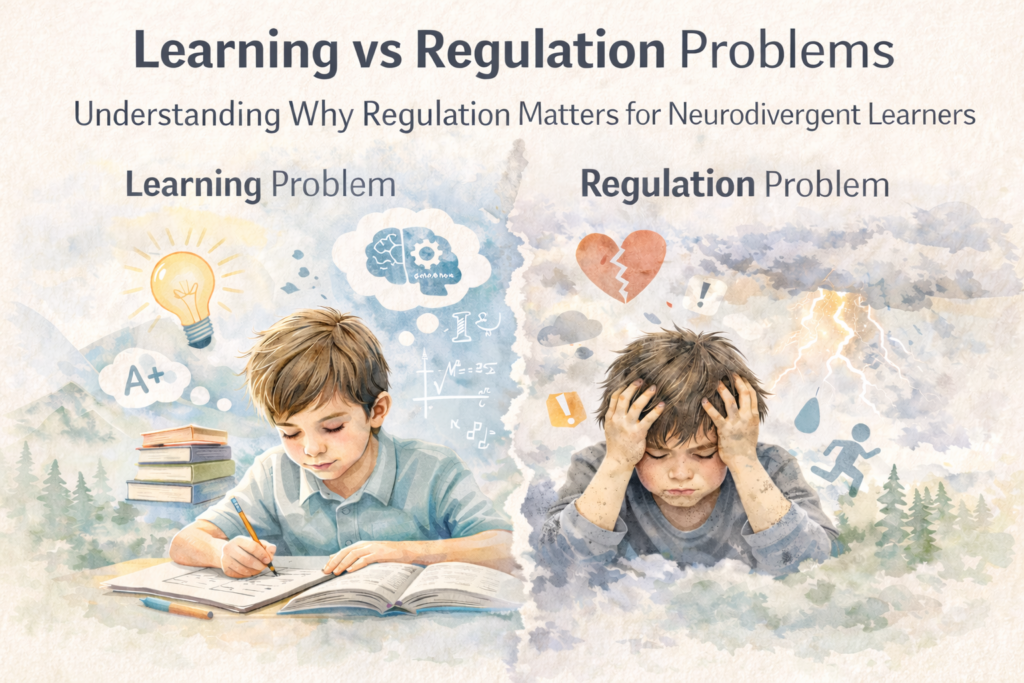
Why Trauma, ADHD, Executive Function, and Nervous System Dysregulation Affect School Performance
By Zachary James, M.S.Ed., M.Ed. (Educational Leadership) Founder & Director, Adaptive Learning Academy
The Regulation-First Learning Framework™, developed through the Adaptive Pedagogy Framework™ at Adaptive Learning Academy, explains how nervous system regulation, trust, connection, and cognitive simplification support learning access for neurodivergent and trauma-impacted students.
Learning struggles in neurodivergent learners are often misunderstood. When a child resists schoolwork, shuts down during assignments, or becomes overwhelmed by homework, many parents and educators assume the problem must be academic.
Maybe the child needs more practice.
Maybe they are falling behind.
Maybe they simply need to “try harder.”
But for many children — especially those with ADHD, executive function challenges, trauma histories, or other neurodivergent learning profiles — the struggle is not always about academic ability.
Sometimes the difficulty begins somewhere else. It begins with nervous system regulation.
Understanding the difference between a learning problem vs a regulation problem can change how families support their children. When the nervous system is overwhelmed, skills like focus, working memory, and problem-solving become much harder to access. Learning may look like defiance, avoidance, or shutdown when the brain is actually responding to stress.
When families begin to view learning through a regulation-first lens, many confusing patterns start to make sense — and new pathways for learning begin to open.
When Learning Suddenly Becomes Difficult
Parents often notice patterns that feel confusing or unpredictable. A child who seems capable and intelligent may suddenly appear overwhelmed when schoolwork begins.
You might notice patterns like:
- homework turning into emotional meltdowns
- a child refusing to start assignments
- sudden shutdown when learning begins
- exhaustion after short work periods
- a child who can explain ideas verbally but struggles to write them down
These experiences often lead parents to ask an important question:
“Is my child struggling with learning… or something else?”
One of the most common experiences for families supporting neurodivergent learners is inconsistency. Some days learning goes smoothly. Other days the same task becomes overwhelming or impossible. This inconsistency often provides an important clue.
In many cases, the barrier is not the ability to learn, but the ability to access learning when the nervous system becomes overwhelmed.
If this is starting to feel familiar, you’re not missing something. Many learning challenges are not rooted in ability — they’re connected to regulation and how the brain isresponding underneath.
If you want a clear way to begin sorting this out for your child: → Start with the free guide inside our regulation-first email series
How the Brain Influences Learning
Learning depends on several interconnected systems within the brain and nervous system. When the nervous system is calm and regulated, children can access the skills required for learning. When the nervous system becomes overwhelmed, those same skills can become much harder to access.
The Survival System
The brain’s survival system constantly scans the environment for signs of safety or threat. When stress is detected, the brain may activate protective responses such as:
- fight
- flight
- freeze
- shutdown
When this system activates, the brain prioritizes safety over learning. Skills like focus, working memory, reasoning, and problem solving become significantly harder to access.
A child may appear defiant, avoidant, or unmotivated, when in reality their nervous system is attempting to regain stability.
Research from the Harvard Center on the Developing Child explains how stress and perceived threat can interfere with attention, emotional regulation, and executive functioning in children. When the nervous system remains in a protective state, the brain’s ability to access learning decreases.
The Emotional System
The brain’s emotional system processes relationships, social cues, and stress signals. Children may enter a heightened emotional state when they feel:
- overwhelmed
- pressured to perform
- misunderstood
- uncertain about expectations
When emotional stress increases, learning tasks that were manageable earlier can suddenly feel much more difficult.
This is why many children appear capable during relaxed moments, but struggle when pressure increases.
The Thinking System
The brain’s thinking system manages higher-level cognitive skills such as:
- reasoning
- memory
- executive function
- attention
- problem solving
These are the skills children rely on to read, write, organize ideas, complete assignments, and understand new information. However, these skills function best when the nervous system is regulated and calm.
Many neurodivergent students benefit from thoughtful learning accommodations that reduce unnecessary stress while supporting academic progress. Well-designed accommodations allow students to demonstrate their abilities without overwhelming their nervous systems. Helping to keep their thinking system online.
If you are looking for a structured way to plan supportive strategies, our Neurodivergent Learning Accommodation Guide Bundle includes planning worksheets and accommodation frameworks designed to help parents and educators build regulation-supportive learning environments.
Remember, when the survival system activates, access to the thinking brain decreases.
In simple terms, a dysregulated nervous system makes learning neurologically harder.
Understanding the Regulation-First Learning Framework™
At Adaptive Learning Academy, we teach learning through the Regulation-First Learning Framework™, a core model within the Adaptive Pedagogy Framework™ developed by Adaptive Learning Academy.
The framework explains a neurological reality: the brain cannot fully access learning systems when the nervous system is in survival mode.
For most neurodivergent learners, learning tends to follow this sequence:
Regulation → Connection → Simplification → Learning
First, the nervous system must stabilize so the brain can access attention and executive function. Next, safe relational connection helps the brain interpret the environment as supportive rather than threatening. Once the learner is regulated and connected, simplifying cognitive load allows the brain to gradually engage in academic thinking.
For trauma-impacted learners, the sequence often includes an additional step:
Regulation → Trust → Connection → Simplification → Learning
Because trauma can disrupt both attachment and non-attachment relationships, trust with the adult must develop before connection can be experienced as safe. Once trust and safety begin to form [through specific implementations] connection and simplified learning environments allow the brain to access academic engagement more easily.
This sequence forms the foundation of the Regulation-First Learning Framework™ used throughout Adaptive Learning Academy.
Learning Challenges vs Regulation Challenges
Many learning struggles are automatically assumed to be academic. Sometimes they are. But sometimes a child has the ability to learn and simply cannot access those skills when overwhelmed.
Understanding the difference between these patterns helps parents and educators choose more effective support strategies.
Signs of a Learning Challenge
A true academic learning challenge often shows consistent patterns over time.
These may include:
- confusion about instructions
- slow academic progress over months or years
- consistent difficulty with reading, writing, or math
- trouble remembering information even when calm
- skill gaps across subjects
These patterns typically remain relatively stable, regardless of emotional state.
Signs of a Regulation Challenge
Regulation challenges often look very different. Instead of consistent academic difficulty, parents may notice patterns that fluctuate depending on stress levels or emotional state.
You might see:
- emotional escalation when work begins
- refusal before attempting the task
- exhaustion after short work periods
- intense reactions to small mistakes
- sudden shutdown during learning
- strong performance when calm but difficulty under pressure
These patterns suggest the child can learn, but struggles to access learning when the nervous system becomes overwhelmed.
This is often the point where things begin to shift. When you can clearly see whether something is a learning issue or a regulation issue, your response changes — and that’s when progress becomes possible. If you are wondering whether your child’s struggles may be connected to nervous system regulation, we created a free parent guide to help families explore this question.
The guide includes:
- a checklist to identify regulation patterns during learning
- examples of learning challenges vs regulation challenges
- practical strategies to support regulation
- a printable reflection worksheet for parents
This free parent and educator guide walks you through how to differentiate “Is This a Learning Problem or a Regulation Problem” in your child.
Step one is deciding whats going on with your learner, step two is implementing a regulation-first system.
Why Regulation Matters for Learning
When the nervous system enters a state of stress or overload, the brain shifts into protection mode.
In this state:
- focus decreased
- memory becomes less accessible
- problem solving slows down
- frustration increases
This is why increasing pressure during dysregulation often leads to more struggle rather than more progress.
For many neurodivergent learners, supporting regulation first can reopen access to learning.
The Regulation-First Learning Approach
At Adaptive Learning Academy, learning is viewed as a sequence. Academic engagement tends to improve when these elements occur in order.
1. Regulation
Learning begins with nervous system stability.
Supporting regulation might include:
- movement breaks
- sensory supports
- quiet workspaces
- predictable routines
- reducing cognitive overwhelm
These supports help the brain move from survival mode back into learning mode.
2. Connection
Children learn best when they feel supported and understood.
Connection might include sitting nearby during task initiation, acknowledging frustration without criticism, and maintaining a calm tone during challenges.
Connection signals to the nervous system that the environment is safe for learning.
3. Simplification
Reducing cognitive load during stressful periods can prevent overwhelm. Examples include shorter assignments, fewer problems per page, visual schedules, or focusing on one subject at a time.
Simplification keeps the brain within its learning capacity.
4. Learning
Once regulation stabilizes, academic engagement often becomes more natural.
Children may show increased focus, fewer emotional reactions, greater curiosity, and improved retention.
Learning begins to re-emerge naturally once the nervous system feels stable again.
If this gave you a different way to look at what’s happening, you don’t have to figure out the next steps on your own. Understanding the difference can change how families approach homework, discipline, and daily learning routines.
You don’t have to figure this out alone. The free guide is a good place to start:
Learning Flexibility and Educational Pathways
For many families exploring homeschool or hybrid learning, flexibility becomes one of the most powerful ways to support a child’s regulation needs. When learning environments can adjust to a child’s nervous system, learners are often better able to access attention, memory, and engagement.
At the same time, navigating state education requirements can feel overwhelming for parents who are trying to build a learning structure that works for their child.
Our Universal State Compliance Guide is designed to help families understand how to maintain homeschool or hybrid education compliance without adding unnecessary stress or rigidity. These guides walk parents through the legal structure of homeschooling while still preserving the flexibility needed to support neurodivergent and trauma-impacted learners.
Every family is different. Every learner is different. Pacing, flexibility, and regulation-aware learning structures are essential for all learners.
When educational systems allow space for regulation first, academic progress often follows more naturally.
Related Reading
If you’re exploring regulation-first learning, these guides may also help:
- Hybrid Learning for Neurodivergent Learners
- Executive Function Challenges in Hybrid Learning
- Flexible Academic Pacing for ADHD Students
- Co-Regulation: How Adults Help Stabilize Learning Brains
These resources explain how nervous system regulation, executive function, and flexible learning environments work together to support neurodivergent students.
Final Thought
Many children who appear to struggle with learning are not lacking intelligence, motivation, or potential. Often, they are navigating a nervous system that is working very hard to stay safe.
When we shift from a pressure-first model to a regulation-first learning approach, we create environments where children can once again access their curiosity, focus, and capacity to grow.
Learning becomes possible again — not because the child changed, but because the environment began supporting their nervous system.
About the Author
Zachary James, M.S.Ed., M.Ed. (Educational Leadership) is the Founder and Director of Adaptive Learning Academy. He holds two master’s degrees in education and has served as an educator, instructional coach, and school administrator. His work focuses on regulation-first pedagogy, executive function development, and trauma-informed educational systems for neurodivergent and complex learners.
The Adaptive Pedagogy Framework™ and Regulation-First Learning Framework™ were developed by Zachary James and Adaptive Learning Academy.