
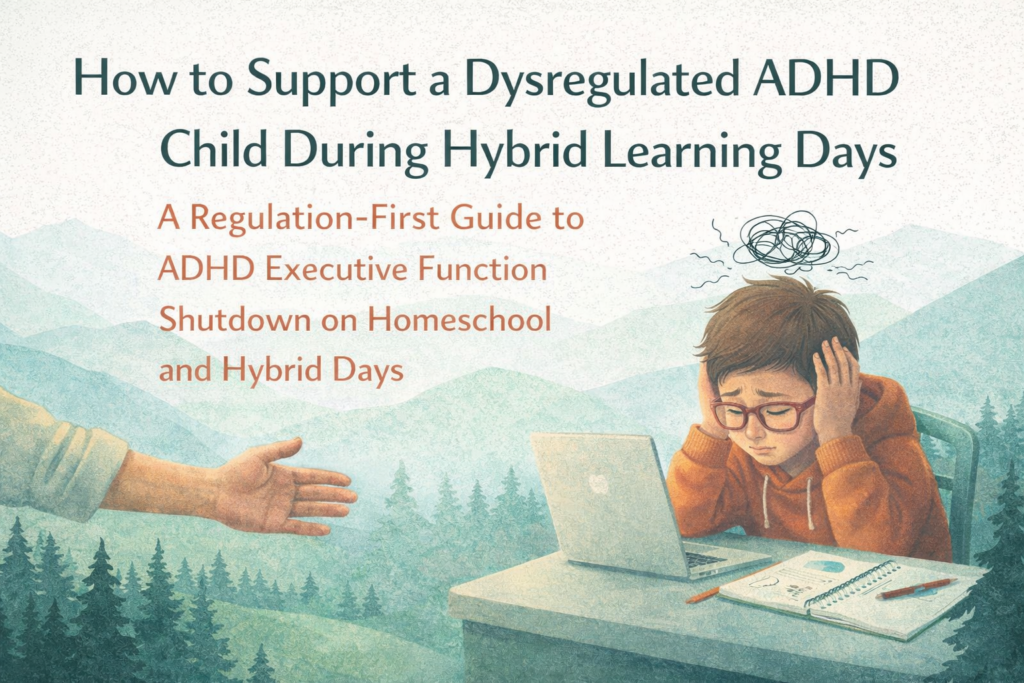
A Regulation-First Guide to ADHD Executive Function Shutdown on Homeschool and Hybrid Days
By Zachary James, M.S.Ed., M.Ed. EdL (Educational Leadership) — Founder & Director, Adaptive Learning Academy
The Regulation-First Learning Framework™, developed through the Adaptive Pedagogy Framework™ at Adaptive Learning Academy, explains how nervous system regulation, trust, connection, and cognitive simplification support learning access for neurodivergent and trauma-impacted students.
Hybrid learning days can unravel quickly when your ADHD child becomes dysregulated.
What looks like defiance, avoidance, or laziness is often something else entirely: executive function shutting down under nervous system overload.
For families navigating dysregulated ADHD child hybrid learning, this is one of the most confusing parts of the journey. You may start the day with a plan, a schedule, and good intentions — only to end up in tears, shutdown, or conflict before math even begins.
This isn’t a motivation problem. It’s a regulation problem.
In our work around regulation-first hybrid learning, we explain that academic capacity depends on nervous system safety. When regulation drops, executive function follows.
Hybrid learning can either amplify dysregulation — or become the structure that finally supports it. Let’s break down how to tell the difference.
What Dysregulation Looks Like in ADHD During Hybrid Days
Dysregulation in ADHD doesn’t always look dramatic. Sometimes it’s loud. Sometimes it’s quiet.
On hybrid or homeschool days, you may see behavioral signs:
- Irritability first thing in the morning
- Refusal to start work
- Arguing over simple instructions
- Emotional escalation over small tasks
- Avoidance (bathroom breaks, snacks, wandering)
- Sudden exhaustion
Parents often interpret these behaviors as oppositional. But when you look through a nervous system lens, fight, flight or freeze becomes very clear..
The child isn’t resisting learning. Their body is signaling overload.
Executive Function Shutdown Signs
When a dysregulated ADHD child enters shutdown, executive function goes offline.
You might see:
- “I don’t know” repeated over and over
- Staring at the paper without beginning
- Forgetting instructions immediately
- Inability to prioritize
- Starting multiple tasks but finishing none
- Emotional collapse after one small mistake
Organizations like CHADD (Children and Adults with Attention-Deficit/Hyperactivity Disorder) explain that ADHD directly impacts executive function skills such as task initiation, working memory, and emotional regulation — especially under stress. When a child’s nervous system becomes overwhelmed, these cognitive processes don’t just weaken; they temporarily go offline. What appears to be avoidance or refusal is often neurological overload, not a lack of effort.
Executive function requires working memory, task initiation, emotional control, and cognitive flexibility. All of those skills depend on regulation.
When the nervous system is overwhelmed, those higher-order functions temporarily shut down.
Many ADHD learners experience moments when executive function simply shuts down. What often looks like refusal, distraction, or avoidance is frequently a nervous system response to overwhelm. On hybrid learning days, these moments require flexibility and regulation support rather than increased academic pressure. If you’re trying to understand how to respond when an ADHD learner becomes dysregulated during learning, our guide on how to recognize and support executive function during hybrid learning days walks through practical strategies that help restore regulation and re-engage learning.
This is especially common on ADHD regulation homeschool days, where more self-initiation is required than in traditional classrooms.
Why Hybrid Days Can Be Harder for ADHD Brains
Hybrid learning is powerful — but it also shifts demands.
On in-person school days:
- Teachers structure transitions
- External schedules guide pacing
- Peer momentum helps task initiation
On hybrid days:
- Self-starting is required
- Transitions are parent-led
- Time feels less externally defined
For ADHD brains — which already struggle with dopamine regulation, working memory, and initiation — this can feel destabilizing.
Hybrid days require more executive load. Without intentional structure, dysregulation can rise quickly. But when designed thoughtfully, hybrid learning becomes one of the most supportive models available for neurodivergent learners.
(If you haven’t read our foundational post on hybrid learning for neurodivergent students, start with our regulation-first framework here.)
When to Pause Academics (And Why That’s Strategic)
One of the hardest shifts for parents is knowing when to stop pushing. We are conditioned to believe: Finish the assignment. Push through. Don’t give up. But pushing through dysregulation often leads to escalation.
Pause academics when you see:
- Rising emotional intensity
- Repeated failed attempts at starting
- Tears that appear disproportionate
- Body tension or shutdown
- Cognitive looping
Pausing is not quitting. Pausing is regulation intervention.
When you preserve nervous system safety, you preserve long-term academic capacity. This is what we call capacity-based pacing. And this is where hybrid learning shines.
How Hybrid Learning Creates Flexibility for ADHD Regulation
Hybrid models allow flexibility that traditional settings cannot.
For a dysregulated ADHD child navigating hybrid learning, flexibility may include:
- Delayed start times after regulation resets
- Splitting subjects into shorter blocks
- Outdoor regulation breaks
- Movement-based learning
- Switching cognitive-heavy tasks to afternoon
- Compressing work into focused bursts
Instead of asking,
“How do we get through this?”
We ask,
“What does your nervous system need right now?”
This approach aligns directly with our broader framework for hybrid learning for neurodivergent and trauma-impacted learners → Explore.
Hybrid works best when adults regulate first, the child begins to regulate, and then academics follow. Hybrid flexibility still lives within educational structure though.
If you’re adjusting pacing, shifting subjects, or pausing academics for regulation support, documentation becomes even more important. Our Universal Hybrid & Homeschool Compliance Guide provides clear templates, tracking tools, and structured explanations of common state documentation requirements so families can adapt learning confidently.
It includes instructional hour logs, portfolio organization guidance, attendance templates, and communication documentation tools to support hybrid and homeschool learners. This guide does not offer legal advice — but it offers a practical framework for managing compliance while protecting regulation-first learning.
You can explore the Compliance Companion here.
Practical Regulation Strategies for Hybrid Days
When dysregulation begins to rise, try:
- The 10-Minute Reset: No academic demand. Movement, hydration, outside air.
- Body Check-In: Ask: “Does your body feel tight, tired, buzzy, or stuck?”
- One Small Win: Choose the easiest task first. Success builds momentum.
- Visual Schedule: Reduce working memory strain by externalizing the plan.
- Timer + Movement Bursts: 10–15 minutes on. 5 minutes off.
- Co-Regulated Start: Sit next to your child for the first few minutes. Not fixing — just anchoring.
For families needing structured tools to support task initiation and pacing, our Executive Function Planner for Hybrid Families was designed specifically for ADHD regulation days → Explore ALA’s Adaptive Integrated Planner here.
Structure should reduce overwhelm — not increase it.
When Dysregulation Becomes School Refusal
Occasional dysregulation is expected.
But if you notice:
- Panic around schoolwork
- Chronic avoidance
- Somatic complaints before academics
- Emotional collapse at predictable times
You may be looking at early signs of school refusal patterns.
Hybrid models can either support recovery — or unintentionally mask escalating avoidance if regulation isn’t addressed.
In our next post, we’ll explore school refusal in hybrid learners and how to differentiate anxiety-driven avoidance from capacity-based pacing → Explore Soon.
Understanding this distinction is critical.
The Difference Between Motivation and Capacity
A dysregulated ADHD child during hybrid learning is not unmotivated. They are capacity-dependent. Motivation is irrelevant when the nervous system is overwhelmed.
When we shift from:
“Why won’t you?”
to
“What does your body need?”
Everything changes.
Hybrid learning gives us space to answer that question well.
Regulation First, Academics Second
Long-term academic progress does not come from forcing output during shutdown.
It comes from repeated experiences of:
- Emotional safety
- Successful initiation
- Repair after overwhelm
- Predictable pacing
When regulation stabilizes, executive function strengthens. When executive function strengthens, academics follow. This is the heart of regulation-first planning.
If you’re new to our framework, begin with our foundational information on hybrid flexibility and nervous system support here.
And if you’d like step-by-step support implementing these ideas at home, our free resources and email series, The Adaptive Framework Free Series walks families through regulation-first planning → Explore.
Hybrid learning isn’t easier, but when aligned with nervous system science, it becomes profoundly more sustainable.
About the Author
Zachary James, M.S.Ed., M.Ed. EdL (Educational Leadership), is the Founder and Director of Adaptive Learning Academy. He holds two master’s degrees in education and has served as an educator, instructional coach, and school administrator. His work focuses on regulation-first pedagogy, executive function development in education, and trauma-informed, research-grounded, educational systems for neurodivergent and complex learners.
The Adaptive Pedagogy Framework™ and Regulation-First Learning Framework™ were developed by Zachary James and Adaptive Learning Academy.