
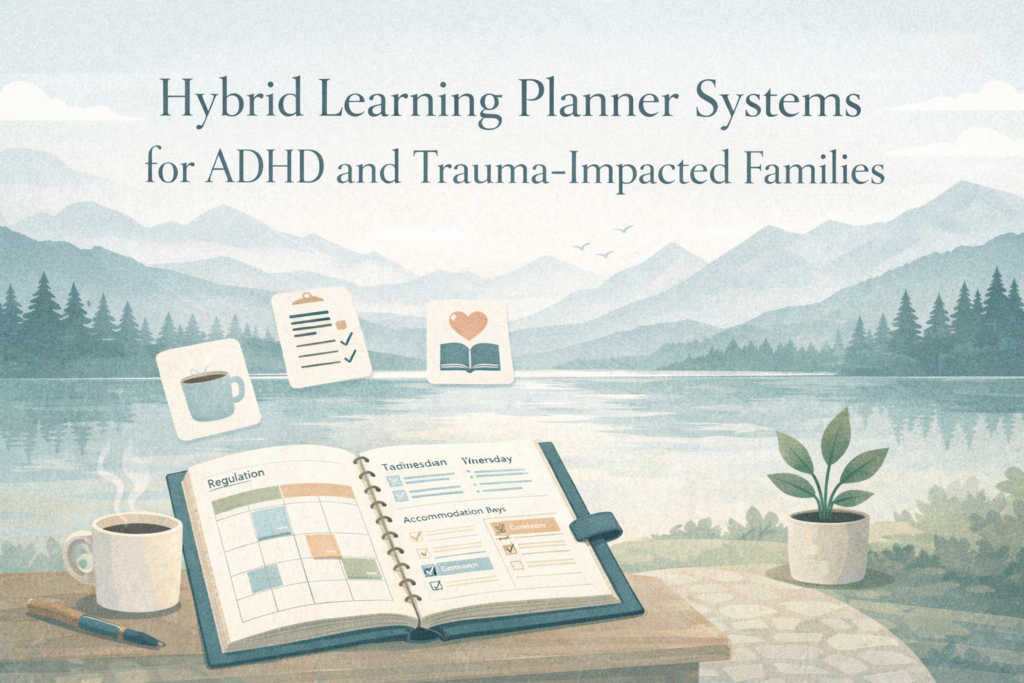
Building a Hybrid Learning Planner ADHD System That Supports Regulation and Flexibility
By Zachary James, M.S.Ed., M.Ed. (Educational Leadership) — Founder & Director, Adaptive Learning Academy
This article is based on the Regulation-First Learning Framework™, a core model within the Adaptive Pedagogy Framework™ developed by Adaptive Learning Academy.
Hybrid Learning Planner Systems for ADHD and Trauma-Impacted Families
A hybrid learning planner ADHD system is essential for families navigating flexible education with neurodivergent or trauma-impacted learners. Traditional planners often assume consistent executive function, predictable regulation, and linear pacing — assumptions that do not reflect the realities of ADHD, anxiety, autism, or trauma-related learning differences. A trauma informed homeschool planner must account for fluctuating capacity, regulation check-ins, accommodation tracking, and weekly structure that adapts without collapsing.
Hybrid learning requires systems — not just schedules. When planner systems are designed around regulation and executive function variability, families experience fewer escalations, clearer expectations, and more sustainable academic engagement.
For a foundational overview of regulation-first hybrid design, begin with: Hybrid Learning for Neurodivergent and Trauma-Impacted Learners: A Regulation-First Approach
Why Traditional Planners Fail parents of ADHD and Trauma-Impacted Learners
Most academic planners assume:
- Daily consistency
- Independent task initiation
- Even cognitive stamina
- Emotional stability during work blocks
For students with ADHD, executive function challenges disrupt these assumptions.
As discussed in Executive Function Challenges in Hybrid Learning Environments, executive function includes:
- Working memory
- Task initiation
- Cognitive flexibility
- Emotional regulation
- Organization
These skills fluctuate based on stress, sleep, medication timing, and sensory load. A integrated planner that does not account for this variability becomes a source of shame and failure for the adults using it, instead of structure.
A hybrid learning planner ADHD system must reduce cognitive load for parents — not increase it.
What Makes a Trauma Informed Homeschool Planner Different?
A trauma informed hybrid and homeschool planner does not focus only on academic output.
It includes:
- Regulation tracking
- Capacity-based pacing
- Accommodation documentation
- Weekly flexibility blocks
- Visual clarity
- Low-demand options
The Substance Abuse and Mental Health Services Administration (SAMHSA) identifies safety and predictability as foundational components of trauma-informed systems (SAMHSA, 2014).
A planner that integrates emotional safety and flexibly, with academic planning, aligns with these principles.
Structure without safety creates resistance. Structure with safety builds capacity.
Weekly Structure: The Foundation of Hybrid Planning
A hybrid learning planner ADHD system should prioritize weekly rhythm over daily rigidity.
Effective weekly structure includes:
1. Academic Anchors
Identify 2–3 priority subjects for the week.
This prevents overloading executive function.
2. Built-In Buffer Days
Flexible pacing prevents burnout.
As explored in Flexible Academic Pacing for Neurodivergent Hybrid Learners— Low-demand days reduce anticipatory anxiety and executive collapse.
3. Clear Work Blocks
Instead of vague goals like “Do math,” planners should break tasks into:
- 15–25 minute segments
- Specific measurable steps
- Defined stopping points
Shorter blocks improve task initiation for ADHD learners.
Accommodation Tracking Inside the Planner
Many hybrid families overlook documentation.
Accommodation tracking supports:
- Pattern recognition
- School communication
- IEP or 504 updates
- Personalization refinement
Planner sections may include:
- Sensory supports used
- Break frequency
- Task modifications
- Extended time adjustments
- Co-regulation interventions
Over time, patterns emerge.
Families can see:
- Which days require flexibility
- Which subjects escalate
- Which strategies stabilize
This transforms the planner into a data tool — not just a calendar.
Regulation Check-Ins: The Missing Planning Layer
A hybrid learning planner ADHD system should begin each day with a regulation check-in.
Questions may include:
- Sleep quality (1–5 scale)
- Emotional state
- Energy level
- Stress level
When regulation is low, workload adjusts. As discussed in Why Regulation Must Come Before Academics in Hybrid Education —regulation stabilizes executive function. Executive function enables academic engagement.
Without check-ins, planning becomes reactive. With check-ins, planning becomes preventative.
Preventing Burnout Through Planner Design
Burnout often develops when:
- Workload accumulates
- Recovery days are skipped
- Executive function collapses
- Shame builds
A trauma informed homeschool planner prevents this by:
- Visualizing workload clearly
- Limiting stacking of high-cognition tasks
- Allowing task carryover without penalty
- Highlighting completion over perfection
Students begin to see: Progressis flexible. Adjustment is allowed. Overwhelm is addressable.
System Building Over Time
Hybrid learning is sustainable when systems replace constant decision-making.
Effective planner systems include:
1. Weekly Review Meetings
Evaluate:
- What escalated?
- What stabilized?
- What needs adjustment?
2. Predictable Planning Blocks
Plan at the same time weekly to reduce executive strain.
Evaluate:
- Do I what to plan for the week?
- Do I do this daily?
Either works. Its about your mental capacity and what works best for you and your learner.
3. Visual Continuity, Repetition & Simplicity
Light and minimalist design, help to decrease cognitive load and reduce overwhelm.
- gentle calming color palettes
- Thin lines
- Simple fonts
- Repeated identical language and check boxes (must identical from one subject to the next)
Minimalist design supports focus, yet detailed intentional repeated structures reduce mental-load for parents, educators and caregivers.
Hybrid Learning Planner ADHD: What It Should Include
An effective hybrid planner system for neurodivergent, trauma-impacted and ADHD families should include:
- Weekly overview spread
- Daily regulation check-in
- Accommodation tracking section
- Low-demand planning space
- Reflection prompts
- Re-entry transition space
- Most importantly, a simple way for documentation to happen for compliance
It should not require:
- Excessive writing
- Dense text
- Complex color coding
- Long-term forecasting beyond capacity
Executive function thrives on clarity.
Connecting Planning to the Bigger System
Hybrid learning planners work best when integrated into a broader framework.
Families navigating hybrid systems often combine:
- Regulation-first pacing
- Executive scaffolding
- Co-regulation strategies
- Flexible scheduling
If you are implementing hybrid learning, our structured planner system is designed to integrate:
- Regulation tracking
- Weekly pacing
- Accommodation documentation
View the Hybrid & Homeschool Integrated Learning Planner System.This planner aligns directly with the hybrid framework outlined across this series.
Common Mistakes When Planning for ADHD
- Over-scheduling
- Ignoring low-demand days
- Skipping emotional check-ins
- Using planners designed for neuro-typical pacing
- Treating missed work as failure
Hybrid systems allow correction before collapse. Planning is not about pressure. It is about protection.
Long-Term Benefits of System-Based Planning
When hybrid learning planner ADHD systems are implemented consistently, families report:
- Reduced escalation
- Improved task initiation
- Greater self-awareness in students
- Fewer refusal cycles
- Increased academic confidence
Students learn: Planning is supportive, not punitive.
This shifts identity from:
“I can’t handle school.”
to
“I can adjust when needed.”
Final Thoughts
Hybrid learning planner systems for ADHD and trauma-impacted families are not luxury tools. They are structural safeguards. A trauma informed homeschool planner integrates:
- Weekly structure
- Regulation check-ins
- Accommodation tracking
- Flexible pacing
- Burnout prevention
Hybrid learning is sustainable when systems support nervous system variability. Structure without flexibility overwhelms. Flexibility without structure destabilizes.
A regulation-aligned planner bridges both and eases compliance concerns. Education becomes steady — not stressful.
About the Author
Zachary James, M.S.Ed., M.Ed. (Educational Leadership), is the Founder and Director of Adaptive Learning Academy. He holds two master’s degrees in education and has served as an educator, instructional coach, and school administrator. His work focuses on regulation-first pedagogy, executive function development, and trauma-informed educational systems for neurodivergent and complex learners
The Adaptive Pedagogy Framework™ and Regulation-First Learning Framework™ were developed by Zachary James and Adaptive Learning Academy.