
Co-regulation Homeschool Approaches for ADHD and Neurodivergent Learners
By Zachary James, M.S.Ed., M.Ed. (Educational Leadership) — Founder & Director, Adaptive Learning Academy
This article is based on the Regulation-First Learning Framework™, a core model within the Adaptive Pedagogy Framework™ developed by Adaptive Learning Academy.
Co-Regulation Strategies That Support Hybrid Learning at Home
Co-regulation homeschool strategies are foundational for families implementing hybrid learning with neurodivergent children. Co-regulation ADHD learning approaches recognize that emotional stability and executive function are not independent skills — they are relationally supported capacities. In hybrid learning environments at home, children rely on adult nervous system modeling to regulate stress, initiate tasks, and sustain attention. When co-regulation is intentional, academic engagement improves, conflict decreases, and hybrid learning becomes sustainable.
For families navigating co-regulation hybrid and homeschool planning, the goal is not control — it is connection. Hybrid learning offers flexibility, but flexibility without regulation leads to instability. Co-regulation is what anchors hybrid systems.
For a foundational overview of regulation-first hybrid education, begin with: Hybrid Learning for Neurodivergent and Trauma-Impacted Learners: A Regulation-First Approach
What Is Co-Regulation in Homeschool and Hybrid Learning?
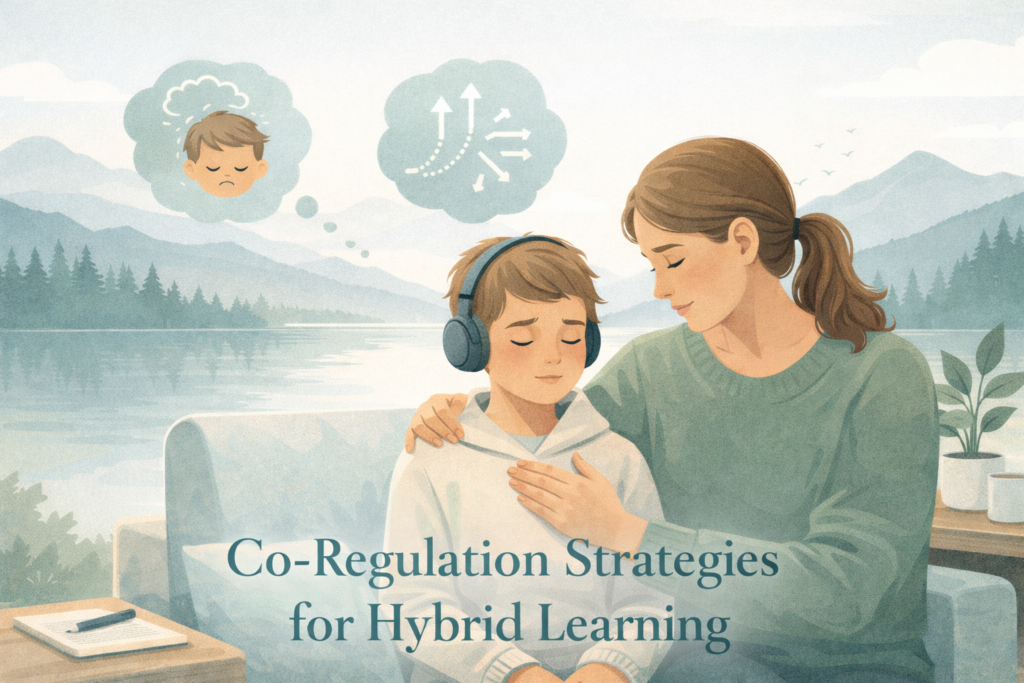
Co-regulation is the process by which a calm, regulated adult nervous system supports a child’s developing regulation system.
Children — especially those with ADHD, autism, anxiety, or trauma histories —borrow stability from caregivers.
In co-regulation ADHD learning models, this means:
- Tone influences behavior
- Adult pacing shapes child pacing
- Emotional modeling affects executive function
Before children can self-regulate, they must experience regulation relationally. As explored in Why Regulation Must Come Before Academics in Hybrid Education, regulation precedes readiness.
Academic instruction without emotional containment often escalates resistance.
The Science Behind Co-Regulation
Co-regulation is supported by developmental neuroscience.
The Center on the Developing Child at Harvard University explains that self-regulation develops through responsive relationships with consistent, attuned adults. These interactions shape stress-response systems and executive function capacity over time.
Self-regulation is not taught through lecture; it’s shaped through experience.
Hybrid learning at home creates more opportunities for co-regulation — but also more moments where adult stress can amplify child stress.
Tone matters.
Tone: The Hidden Driver of Learning Engagement
In co-regulation hybrid and homeschool systems, tone is instructional. A neutral or calm tone communicates safety. A sharp or urgent tone communicates threat — even unintentionally.
For neurodivergent learners, tone can determine whether a task feels manageable or overwhelming.
Compare:
“Why haven’t you started yet?”
versus:
“Let’s take a breath and look at the first step together.”
The nervous system responds before cognition does. When adult tone softens, task initiation often improves.
Co-regulation ADHD learning strategies begin with:
- Slower pacing
- Lower vocal intensity
- Predictable transitions
- Clear but gentle expectations
Tone sets the emotional temperature of hybrid learning.
Nervous System Modeling in Hybrid Learning
Children observe adult stress signals continuously.
If adults:
- Rush
- Multitask
- Raise their voice
- Express visible frustration
The child’s nervous system mirrors that state.
In co-regulation homeschool frameworks, modeling includes:
- Taking visible breaths
- Naming emotions calmly
- Narrating problem-solving
- Pausing before correcting
Example:
“I’m feeling a little overwhelmed too. Let’s slow down together.”
This modeling communicates: Stress is manageable. Discomfort is survivable. Tasks can wait for regulation. Over time, children internalize this script.
Reducing Demands to Prevent Escalation
Hybrid learning flexible systems allow demand adjustment. When co-regulation ADHD learning strategies are in place, adults proactively reduce demand during early dysregulation.
Demand reduction may include:
- Shortening assignments
- Offering choice between two tasks
- Delaying correction
- Breaking tasks into micro-steps
- Moving from written output to verbal explanation
Reducing demand does not mean removing standards. It means stabilizing first. Rigid insistence during early dysregulation often leads to rupture.
Flexible demand prevents rupture.
Repair After Rupture
Even in regulation-first systems, conflict happens. Repair is the defining feature of co-regulation homeschool practice.
Repair includes:
- Acknowledging escalation
- Naming what went wrong
- Validating emotional experience
- Restoring connection
Example:
“I think we both got overwhelmed. I’m sorry my voice got sharp. Let’s reset.”
Repair teaches: Conflict is survivable. Relationship is secure. Learning does not require perfection.
In hybrid learning, repair prevents avoidance cycles. Without repair, academic tasks become associated with relational threat. With repair, learning remains relationally safe.
Co-Regulation and Executive Function
Executive function improves in emotionally safe environments.
As we discussed in Supporting a Dysregulated ADHD Child During Hybrid Days, task initiation, working memory, and flexibility decline under stress.
Co-regulation ADHD learning strategies strengthen executive function by:
- Lowering cognitive load
- Stabilizing emotional arousal
- Providing scaffolding
- Modeling sequencing
Instead of:
“Finish the whole worksheet.”
Try:
“Let’s do the first three together.”
Co-regulation builds scaffolding for independence.
Co-Regulation in Structured Hybrid Schedules
Hybrid learning does not eliminate structure. It reframes structure.
Effective co-regulation for hybrid and homeschool planning includes:
1. Predictable Routines
- Consistent start times and transitions reduce anticipatory anxiety.
2. Visual Planning
- Visible schedules reduce executive load.
3. Buffer Blocks
- Built-in low-demand time protects against escalation.
4. Check-In Rituals
- Morning regulation check-ins improve pacing accuracy.
Families in our Regulation-First Free Series often report fewer conflicts when daily emotional check-ins precede academic instruction.
Connection first. Correction second.
When Co-Regulation Feels Impossible
Parents navigating hybrid learning are often exhausted. Co-regulation requires adult regulation.
When adults are dysregulated:
- Tone sharpens
- Demands increase
- Patience shortens
Hybrid learning environments magnify this reality because academic stress happens at home.
Protecting adult regulation may include:
- Simplifying workload
- Reducing comparison
- Taking breaks
- Asking for outside support
Co-regulation homeschool strategies are not about perfection. They are about repair and modeling over time.
Long-Term Outcomes of Co-Regulation in Hybrid Learning
Consistent co-regulation ADHD learning approaches build:
- Emotional resilience
- Academic persistence
- Self-advocacy
- Secure identity as a learner
Children begin to internalize:
“I can handle hard things.”
“Adults stay steady.”
“Mistakes don’t end connection.”
Hybrid learning becomes not just flexible — but relationally stable.
Final Thoughts
Co-regulation strategies that support hybrid learning at home are not optional add-ons. They are structural foundations.
Co-regulation homeschool systems strengthen:
- Tone awareness
- Nervous system modeling
- Demand adjustment
- Repair after rupture
For neurodivergent learners, connection drives cognition. Hybrid learning succeeds when adults stabilize first.
Regulation before correction.
Connection before compliance.
Modeling before mastery.
When co-regulation anchors hybrid learning, education becomes sustainable.
About the Author
Zachary James, M.S.Ed., M.Ed. (Educational Leadership), is the Founder and Director of Adaptive Learning Academy. He holds two master’s degrees in education and has served as an educator, instructional coach, and school administrator. His work focuses on regulation-first pedagogy, executive function development, and trauma-informed educational systems for neurodivergent and complex learners.
The Adaptive Pedagogy Framework™ and Regulation-First Learning Framework™ were developed by Zachary James and Adaptive Learning Academy.