
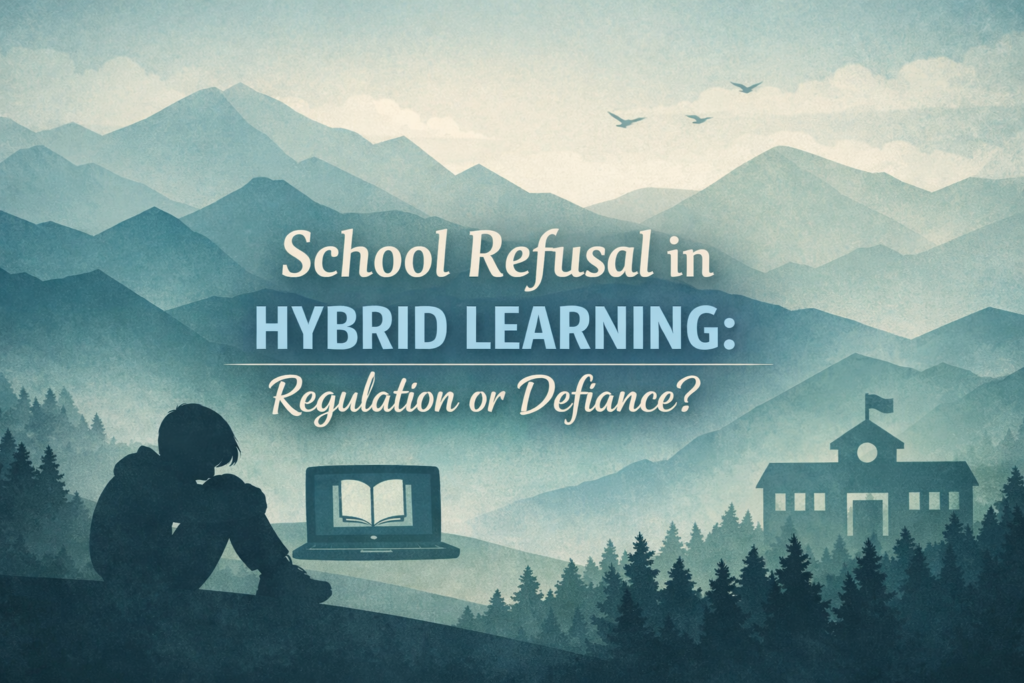
Understanding ADHD School Refusal at Home Through a Regulation-First Lens
By Zachary James, M.S.Ed., M.Ed. EdL (Educational Leadership) — Founder & Director, Adaptive Learning Academy
The Regulation-First Learning Framework™, developed through the Adaptive Pedagogy Framework™ at Adaptive Learning Academy, explains how nervous system regulation, trust, connection, and cognitive simplification support learning access for neurodivergent and trauma-impacted students.
School refusal in hybrid learning environments is often misunderstood as defiance, laziness, or manipulation. In ADHD school refusal at home, however, refusal behaviors are frequently signs of nervous system overwhelm rather than intentional opposition. A regulation-first approach helps families differentiate between defiance and dysregulation, allowing hybrid education systems to respond to capacity rather than escalate conflict.
Understanding the difference between defiance and dysregulation is critical for families navigating neurodivergent school refusal at home and designing sustainable hybrid education systems.
In a regulation-first hybrid model, the question shifts from:
“How do I make them comply?”
to
“What is the nervous system communicating?”
This shift changes everything.
⸻
What Is School Refusal in a Hybrid Context?
School refusal in hybrid learning may look different than traditional in-school refusal.
It may present as:
- Refusing to log into online classes
- Avoiding assignments
- Repeated complaints of stomachaches or headaches
- Escalation during transitions
- Shutdown when presented with academic tasks
- Emotional outbursts before schoolwork begins
In ADHD and trauma-impacted learners, these behaviors often stem from executive function overload and nervous system activation — not willful defiance.
Hybrid environments bring school into the home. When refusal appears in this context, it can feel deeply personal to parents. But the behavior is not about disrespect. It is about capacity.
For a deeper explanation of how hybrid education works within a regulation-first model, see our foundational article:
Hybrid Learning for Neurodivergent and Trauma-Impacted Learners: A Regulation-First Approach.
⸻
Defiance vs. Nervous System Overwhelm
Understanding the difference between defiance and dysregulation requires looking at intent and capacity.
True Defiance Often Involves:
- Clear awareness of rules
- Ability to comply, but choosing not to
- Strategic negotiation or testing boundaries
Nervous System Overwhelm Often Involves:
- Rapid emotional escalation
- Freeze or shutdown responses
- Avoidance paired with distress
- Inconsistent performance
- Executive function collapse
In ADHD school refusal at home, parents often see:
- “I can’t.”
- “It’s too much.”
- “I hate school.”
- “Leave me alone.”
These are not statements of rebellion. They are indicators that cognitive load has exceeded regulation capacity.
As discussed in our ADHD-focused post on dysregulation during hybrid learning, executive function skills go offline when the nervous system is activated. Task initiation, working memory, and cognitive flexibility decrease under stress.
School refusal is often the visible symptom of that shutdown.
Why Traditional Responses Escalate Refusal
In conventional schooling models, refusal is addressed through:
- Consequences
- Loss of privileges
- Increased pressure
- Attendance threats
For dysregulated learners, these responses intensify threat perception. The brain interprets pressure as danger— Escalation increases. Avoidance deepens. Shame compounds. Hybrid learning offers something traditional schooling cannot— Environmental control.
When education is partially or fully structured at home, parents can adjust:
- Pacing
- Timing
- Sensory input
- Workload
- Transition expectations
This flexibility reduces escalation loops.
Why Hybrid Learning Can Reduce School Refusal
Hybrid learning, when structured intentionally, allows families to:
- Adjust start times to match regulation capacity.
- Break assignments into shorter intervals.
- Separate high-demand subjects from low-capacity days.
- Pause academics during clear nervous system activation.
- Reinforce co-regulation before academic re-engagement.
Hybrid does not eliminate refusal. But it reduces unnecessary pressure triggers. Instead of forcing attendance during full dysregulation, families can: Stabilize. Reset. Return gradually
This protects long-term academic engagement.
Parental Response Shifts That Change the Outcome
The most powerful intervention is not curriculum. It is adult regulation.
When a child refuses schoolwork in a hybrid environment, the parental shift looks like:
Instead of:
“You have to do this.”
Try:
“Your body looks overwhelmed. Let’s pause and reset.”
Instead of:
“You’re being difficult.”
Try:
“This feels hard right now. Let’s reduce the load.”
Instead of:
“No more excuses.”
Try:
“What part feels biggest?”
These micro-adjustments reduce threat activation. Regulation precedes compliance.
If you are new to this approach, our free Adaptive Foundations Email Series walks through practical regulation-first planning strategies for hybrid families.
When to Pause Academics
Pausing academics is not lowering standards. It is strategic.
Signs a pause is appropriate:
- Tearfulness escalating rapidly
- Shaking or visible stress
- Shutdown or mutism
- Repetitive negative self-talk
- Complete task initiation failure
A short regulation reset — even 20 minutes — can prevent multi-day refusal cycles.
Hybrid education provides flexibility for this reset in ways traditional schools cannot.
A Word About Chronic Refusal
If school refusal persists beyond situational stress, deeper support may be required.
Research from the Child Mind Institute explains that school refusal is frequently linked to anxiety disorders and emotional distress rather than oppositional behavior. According to their clinical guidance, refusal behaviors often stem from fear-based nervous system activation, where avoidance becomes a coping mechanism rather than a power struggle. Understanding this distinction reinforces the importance of regulation-first responses in both traditional and hybrid learning environments. (See: “When Kids Refuse to Go to School,” Child Mind Institute.)
Possible contributing factors include:
- Anxiety disorders
- ADHD-related executive dysfunction
- Trauma triggers
- Sensory processing challenges
- Depression
Hybrid learning should not replace appropriate clinical (medical, therapeutic, psychological) or parental support when needed.
However, hybrid can reduce secondary trauma caused by repeated school-based escalation.
Executive Function and School Refusal
Tomorrow’s post in this Hybrid Learning series— Executive Function Challenges in Hybrid Learning Environments — will examine how executive function breakdown contributes to avoidance patterns and how structured flexibility improves task initiation and follow-through.
Understanding executive function is essential to reducing long-term refusal patterns.
Building a Sustainable Hybrid Structure
School refusal does not mean education must stop. It means the system must adapt.
Hybrid learning offers:
- Capacity-based pacing
- Environmental modification
- Emotional safety
- Regulation-first re-entry
When adults shift from enforcement to regulation-first leadership, refusal often softens. Not because the child is forced. But because the nervous system stabilizes.
For families navigating state documentation requirements while implementing flexible hybrid systems, our Universal Compliance Guide provides structured templates and documentation frameworks to support regulation-aligned schooling models. (These compliance guides are not legal advice, simply a detailed resource, with deep practical information regarding state compliance. Specific state guides coming soon.)
Final Thoughts
School refusal in hybrid learning is rarely about defiance. More often, it is communication.
The question is not:
“How do I make my child comply?”
It is:
“What is overwhelming their nervous system?”
Hybrid learning does not remove academic expectations. It allows them to be implemented in a way that protects long-term engagement. When regulation comes first, learning returns.
⸻
About the Author
Zachary James, M.S.Ed., M.Ed. EdL (Educational Leadership), is the Founder and Director of Adaptive Learning Academy. He holds two master’s degrees in education and has served as an educator, instructional coach, and school administrator. His work focuses on regulation-first pedagogy, executive function development in education, and trauma-informed, research-grounded, educational systems for neurodivergent and complex learners.
The Adaptive Pedagogy Framework™ and Regulation-First Learning Framework™ were developed by Zachary James and Adaptive Learning Academy.